

FAQ about motorcycle lifts: questions on dimensions, capacity, safety and installation
Motorcycle lifts: why choosing the right one matters
The motorcycle lift is one of the central pieces of equipment in a specialised workshop. It is where maintenance, inspections, repairs, disassembly, adjustments and technical operations on the vehicle take place.
Choosing a motorcycle lift does not simply mean buying a platform capable of lifting a bike. It means identifying a solution suited to the available space, the type of vehicles serviced, the workshop’s workload and the technicians’ working method.
Dimensions, capacity, safety and installation are common questions, but they should always be considered together. A lift with the right capacity, if poorly positioned, can make work uncomfortable. A stable, well-built lift that is not integrated into the layout may not express its full potential.
KIRO is not only a Made in Italy manufacturer of motorcycle lifts, but also a design partner: it supports customers in choosing, configuring and integrating the lift within the workshop.
For a broader overview, you can also read the complete guide to motorcycle lifts.
Before buying: the key questions to ask
Before choosing a motorcycle lift, it is useful to clarify a few points: which vehicles are serviced most often? How much space is available? Which operations are performed every day? Will the lift be used by one operator or by several technicians? Does the workshop need a fixed, recessed or more flexible workstation?
These questions help avoid a choice based only on price or a single technical figure. The lift is the centre of the workstation: it must be selected according to real work.
How does a motorcycle lift work?
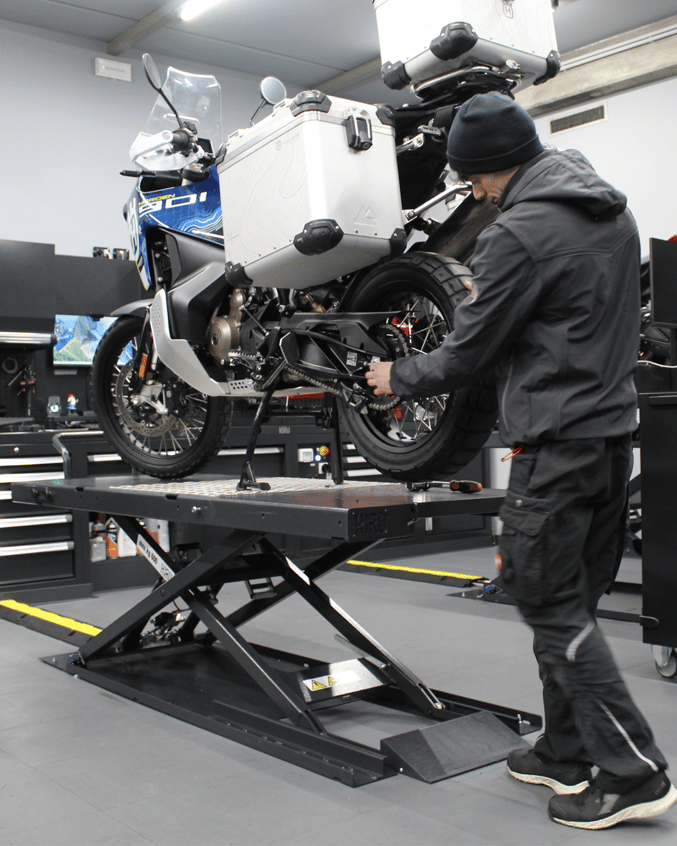
A motorcycle lift brings the vehicle to a more comfortable and safer working height. The platform supports the motorcycle, while the lifting system raises or lowers it according to the type of operation.
For a more technical explanation, you can read KIRO’s article on how a motorcycle lift table works.
How can you identify a professional motorcycle lift?
A professional lift stands out for stability, quality materials, adequate capacity, safety, durability, accessibility and the ability to integrate into the workshop’s daily workflow.
To explore these points in more detail, you can read the article on how to identify a professional motorcycle lift.
Motorcycle lift dimensions
When talking about dimensions, people often focus only on the length and width of the platform. In reality, it is also important to consider the footprint when closed, minimum height, maximum height, space around the workstation, ramp, possible recessed installation and the operator’s freedom of movement.
A motorcycle lift should not simply “fit” inside the workshop. It should allow technicians to work properly.
How long should a motorcycle lift be?
The length should be suitable for the vehicles most frequently serviced by the workshop. Road bikes, scooters, touring motorcycles, racing bikes and more specific vehicles may have different requirements in terms of support, stability and manoeuvrability.
There is no ideal size that works for everyone. A lift that is too short may limit stability and practicality; an oversized lift may take up valuable space. The right choice starts from the vehicles serviced and the layout of the environment.
How wide should a motorcycle lift be?
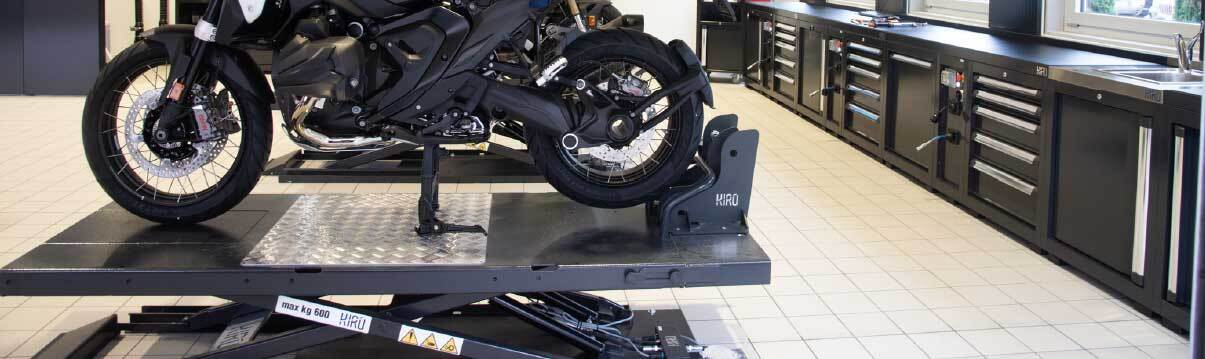
The width must ensure safe support for the vehicle and allow the operator to access the sides of the motorcycle comfortably.
It is not only the platform measurement that matters: you should also consider lateral space for the technician, the tool trolley, any side trays and the operations that require movement around the vehicle.
How much space is needed around the lift?
Around the platform there should be clear passageways, space to move the trolley, room to open drawers, nearby support surfaces and freedom of movement.
A lift placed too close to walls, shelves, benches or other workstations creates constant obstacles. Even a few centimetres, repeated every day, can affect productivity.
Space management concerns the entire workshop layout. For this reason, it can be useful to read the article on designing an efficient motorcycle workshop: the KIRO method.
Can a lift be installed in a small workshop?
Yes, but design becomes even more important. In small workshops, it is necessary to evaluate the lift footprint, ramp, drawer opening, bench position and vehicle movement.
The question is not just “does the lift fit?”, but “does the lift still allow the team to work properly?”. KIRO starts precisely from this logic: designing the workshop around real work.
Minimum and maximum height
In addition to length and width, lift heights are decisive. Minimum height affects motorcycle loading; maximum height affects posture, ergonomics and operator comfort.
Why is minimum height important?
Minimum height determines how easy it is to load the motorcycle onto the lift. The closer the lift is to the floor, the more natural and safer the loading phase becomes.
This is especially important with heavy motorcycles, low vehicles or motorcycles with specific geometries. In the KIRO 400 kg motorcycle lift, reduced minimum height and automatic ramp are designed to make loading easier.
Why does maximum height affect ergonomics?
Maximum height allows the operator to work in a more comfortable position, reducing bending and forced postures.
A well-chosen lift allows the technician to adjust the working height according to the operation. To explore the relationship between lift features, posture and usability, you can also read the article on 5 key factors to consider before buying a motorcycle lift.
Motorcycle lift capacity
Capacity indicates the maximum weight the lift can safely support. It is one of the first figures to evaluate, but it should not be read in isolation: build quality, structural stability and frequency of use also matter.
What capacity should a motorcycle lift have?
The correct capacity depends on the vehicles usually serviced. Lightweight motorcycles, scooters, touring bikes, maxi-enduro, custom motorcycles or heavier vehicles may require different evaluations.
The lift must have a capacity suited not only to the average vehicle weight, but also to the most demanding cases the workshop may need to handle. Accessories mounted on the motorcycle, such as side bags, windscreens or additional components, should also be considered.
Is a 400 kg motorcycle lift enough?
A 400 kg lift can be suitable for many motorcycle workshops, especially when the vehicles serviced remain within that weight limit and the product is designed for professional use.
The KIRO 400 kg motorcycle lift responds to the needs of specialised workshops, with solutions designed to reduce footprint and improve motorcycle accessibility.
Capacity should still be evaluated according to the specific workshop. To see the full range, you can visit the section dedicated to KIRO motorcycle lifts.
Is capacity enough to define quality?
No. A professional lift must guarantee stability, resistance, safety, material quality, reliability of the lifting system and long-term durability.
Capacity is essential, but it does not tell the whole story. A lift must support daily workshop activity without becoming the weak point of the workstation.
Lift movement: manual or electro-hydraulic?
Motorcycle lifts can have different movement systems. This choice affects practicality, speed, control and operator comfort.
When should you choose an electro-hydraulic lift?
In a professional context, where the lift is used frequently and must support continuous work rhythms, an electro-hydraulic system can offer greater operating comfort, reduce physical effort and make work smoother.
It is not just a matter of convenience: a well-designed movement system can improve precision, perceived safety and speed of operation.
For more details, you can read KIRO’s article on how a motorcycle lift table works, which explains the main operating systems.
Motorcycle lift safety
Safety is one of the main topics when choosing a motorcycle lift. A lift must allow the operator to work with stability, control and confidence.
A safe workstation is based on three factors: product quality, correct installation and use in line with the manufacturer’s instructions.
What safety systems should a professional lift have?
A professional lift must ensure stability during lifting and lowering. It is important to evaluate the quality of the structure, locking systems, platform strength and the overall safety of the system.
In KIRO lifts, Made in Italy design is a central element: materials, finishes and technical solutions are developed to meet the daily needs of professional workshops.
How do you work safely on a motorcycle lift?
To work safely, the vehicle must be positioned correctly, the lift must be used according to the manufacturer’s instructions and the area around the workstation must remain clear.
Cables, hoses, tools left on the floor or badly positioned trolleys can create risks even when the lift itself is technically safe. This is why order and layout are part of safety.
For a dedicated focus, you can read the article on motorcycle lift table and safety.
Why do build quality and Made in Italy matter?
The lift supports the vehicle during operations that require strength, precision and access to different areas of the motorcycle. A stable structure allows the technician to work with greater control.
Build quality also affects product durability. In a professional workshop, the lift is used every day and must withstand continuous stress, wear and repeated loads.
For KIRO, Made in Italy is linked to product solidity, attention to detail and the possibility of designing solutions consistent with real work. You can explore this topic in the article on workshops built to perfection and true Made-in-Italy.
Motorcycle lift installation
Installation is a decisive phase. A correctly chosen lift, if poorly positioned, can create more problems than benefits.
Positioning must consider vehicle flow, manoeuvring space, proximity to benches, access to tools, availability of air and power, and operator safety.
Where should the lift be installed in the workshop?
The lift should be installed in an area that supports the natural workflow. The motorcycle must be able to enter, reach the workstation and leave without complex manoeuvres.
The ideal position depends on the type of workshop, number of workstations, vehicles serviced and how the team works every day. For this reason, it can be useful to consider where to position a motorcycle lift in a workshop.
Does the floor need special characteristics?
The floor must be evaluated according to the lift model, installation type and manufacturer’s technical instructions.
If recessed installation is being considered, floor structure, possible excavation, existing systems and building constraints must all be assessed. KIRO does not only consider the product, but the consistency between installation and the real environment.
Is a recessed or above-floor lift better?
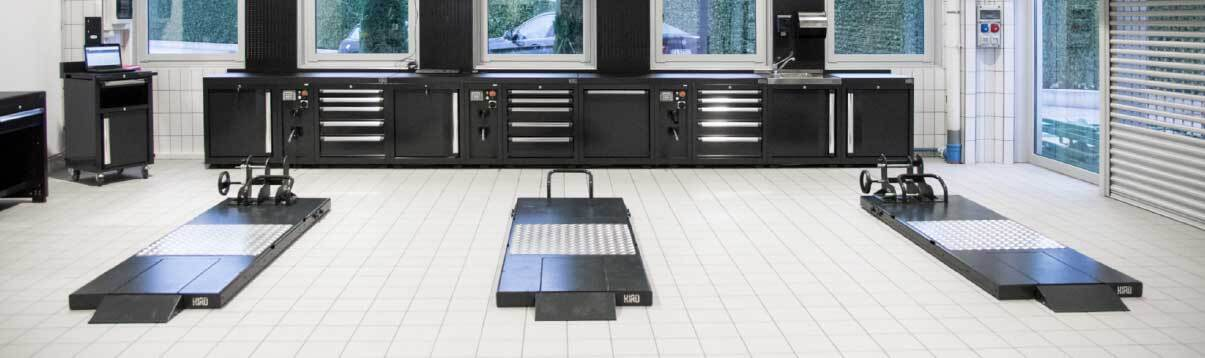
It depends on the workshop. A recessed lift brings the platform level with the floor, reducing height difference and improving loading, unloading and the visual cleanliness of the workstation.
An above-floor lift can be easier to install where the floor cannot be modified. In this case, reduced minimum height, a well-designed ramp and careful footprint management become essential.
KIRO explores this topic in the article on strategic motorcycle lift accessories.
Lift accessories and configurations
Ramp, hatch, side trays, control systems and the possibility of recessed installation can significantly change the way the lift is used every day.
A well-configured lift makes work smoother, reduces obstacles and improves access to the motorcycle.
What is the ramp used for?
The ramp makes motorcycle loading and unloading easier. A well-designed ramp reduces the height difference, makes the vehicle easier to move onto the platform and improves safety during manoeuvres.
In some models, the retractable ramp also reduces footprint once the motorcycle is already positioned.
What is the rear hatch used for?
The rear hatch makes certain operations on wheels, tyres and rear components easier. It allows more comfortable access to the relevant area and can reduce intervention time.
It is especially useful for workshops that frequently handle tyre changes, rear inspections or operations on the rear part of the vehicle.
Are side trays useful?
Yes. Side trays provide additional support surfaces close to the motorcycle. They allow tools, small parts or components to be placed nearby without moving away from the workstation.
They do not replace the bench or trolley, but they complete the lift and make it more practical during daily operations.
How do you choose the right accessories?
Accessories should be chosen according to the most frequent operations. If the workshop often works on wheels and tyres, the hatch is important. If the main issue is access, the ramp or recessed installation may make the difference. If quick support surfaces are needed, side trays can improve workstation order.
To explore this topic, you can read the article on strategic motorcycle lift accessories.
Motorcycle lift and technical furniture
The lift is the centre of the workstation, but it never works alone. Around it, benches, trolleys, utilities, accessories and movement areas must be designed coherently.
A lift installed without considering technical furniture can create an incomplete workstation. The technician may be forced to move away from the vehicle, search for tools in different areas or place components wherever there is space.
Should the lift be close to the workbench?
In most cases, yes. The workshop bench allows technicians to place components, prepare tools, carry out support operations and keep the area tidy.
The distance between lift and bench must be designed: too far away, and the bench loses usefulness; too close, and it may obstruct movement. You can also explore the topic in the article on managing your motorbike workbench.
How important is the tool trolley?
The tool trolley brings tools close to where they are needed. In a well-designed workstation, it supports the technician’s work without obstructing movement.
Lift, bench and trolley should form a single system. To explore technical furniture, you can visit the section on professional motorcycle workshop furniture.
Why do air, power and utilities matter?
Compressed air, electrical power, fluid distribution and service points must be consistent with the lift position. If utilities are far away or improvised, cables, hoses and unnecessary movements increase.
A well-positioned lift should also work with energy and compressed air systems. KIRO’s K-Green solutions show how utilities and technical modules can become part of an organised workstation.
Motorcycle lift maintenance
A professional lift must also be chosen with durability in mind. In a workshop, it is used often, exposed to repeated loads and subjected to intense daily work.
Does a motorcycle lift require maintenance?
Yes. Like any technical equipment, a motorcycle lift requires attention over time. Maintenance may include visual checks, verification of movement systems, cleaning, correct use and compliance with the manufacturer’s instructions.
To learn more, you can read KIRO’s article on motorcycle lift maintenance.
Does maintenance affect safety?
Yes. A well-maintained lift is safer, more reliable and more stable over time. Maintenance helps prevent abnormal wear and malfunctions, especially when the equipment is used every day.
KIRO: manufacturer and workshop designer
To choose a motorcycle lift correctly, it is not enough to compare dimensions, capacity and price. You need to understand how that lift will enter the workshop’s daily workflow.
Every workshop has different spaces, flows, habits and priorities. KIRO starts from this complexity: it does not simply manufacture Made in Italy lifts and furniture, but supports the customer in designing the workshop.
Why does KIRO design the workshop, not just the lift?
Because lift quality is only part of the final result. A functional workshop is the result of several choices: lift position, bench layout, tool organisation, passageways, work areas, utilities and the overall image of the space.
KIRO supports customers in the design process, transforming products and furniture into an environment consistent with the team’s working method.
To explore this approach, you can visit The Workshop Specialists page or read the article on custom workshop equipment.
When should you ask for consultancy?
Consultancy is useful when choosing a new lift, renovating a workstation, expanding a workshop or making better use of available space.
It is also useful when there are doubts about recessed installation, ramp, accessories, bench position, workflows or integration with technical furniture.
Conclusion: choosing a lift means designing a workstation
Dimensions, capacity, safety and installation are essential questions when choosing a motorcycle lift. But the best answer never comes from a single technical figure.
The right lift is the one that adapts to the way the workshop works every day. It must support the vehicles serviced, be safe, occupy the right space, work with benches and trolleys, integrate with utilities and improve the operational flow.
With KIRO, the motorcycle lift is not considered an isolated product. It is the centre of a tailor-made workstation, built around the customer’s needs and made with Made in Italy quality.
To choose the most suitable motorcycle lift for your workshop and design a truly functional workstation, you can contact a KIRO expert.
FAQ
What is the first thing to evaluate?
The real use of the lift: vehicle types, frequency of use, available space, main operations and team needs.
Is a professional lift useful in a small workshop?
Yes, if the workshop works regularly on motorcycles and wants to improve quality, safety and organisation.
Can I choose a lift based only on price?
It is not recommended. Price matters, but an unstable, uncomfortable or unsuitable lift can generate inefficiencies and costs over time.
Should I buy the lift first or design the layout first?
It is better to design the layout first. This way, the lift is chosen according to space, workflows and real needs.