

The productivity of a workshop depends on the way tools, spaces, and movements work together
In a modern workshop, efficiency does not rely only on the quality of individual equipment. A sturdy motorcycle lift, a well-built workbench, or a spacious tool trolley are essential elements, but they become truly effective only when they are integrated into a coherent workshop design.
This is what separates a standard workshop from a custom-designed workshop: the ability to make lifting systems, technical furniture, tools, and operational flows work together. Every gesture should feel natural. Every tool should be within reach. Every movement should have a purpose.
KIRO starts from this vision. The company does not simply manufacture professional workshop equipment; it also supports customers in designing their workspace by studying the layout, equipment positioning, working habits, internal workflows, and real day-to-day needs.
The result is a more organized, safer, and more productive environment: a tailor-made workshop where aesthetics and functionality are not separate concepts, but two parts of the same working method.
The motorcycle lift as the operational center of the workstation
In many workshops, the motorcycle lift is the heart of the workstation. It is where the vehicle is safely positioned, inspected, disassembled, adjusted, and reassembled. Whether it is a motorcycle lift, a lift for quads, or an e-bike lift, the principle remains the same: the lift must allow the operator to work with stability, precision, and continuity.
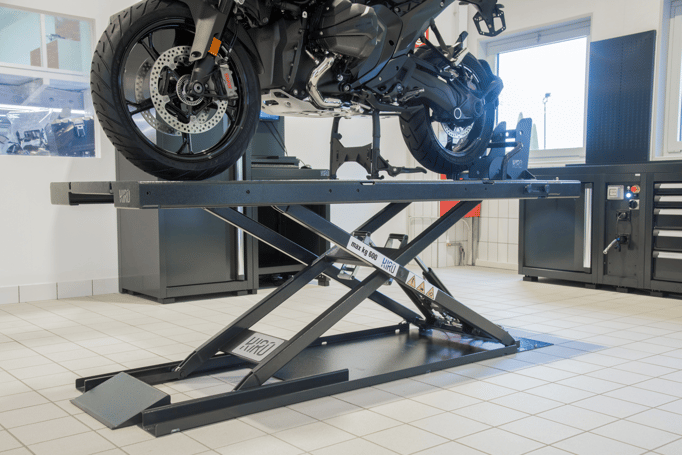 For this reason, a professional lift should never be chosen as a standalone element. It is important to consider how it will be used every day. Where will it be positioned in relation to the workbench? How much space is needed around it for safe movement? Where will tools, power outlets, compressed air, accessories, and consumables be placed? How clear must the passageway remain to ensure safety and maneuverability?
Anyone looking for a professional motorcycle lift, or more broadly a lifting system for their workshop, should think beyond load capacity and dimensions. The real value of a lift also depends on how well it integrates with the entire working environment.
From choosing the lift to designing the workstation layout
A good motorcycle lift should support the work, not complicate it. It should reduce physical effort, improve access to the vehicle, support better posture, and help reduce downtime.
The choice of model should therefore always start from the type of work carried out in the workshop. A workshop focused on routine maintenance will have different needs from one that frequently works on suspensions, racing components, complex repairs, or vehicles of different sizes.
This is where consulting becomes essential. The position of the lift, its minimum height, the possibility of in-ground installation, the presence of hatches, ramps, and accessories are not isolated technical details. They are factors that directly affect the planning of the workshop’s internal workflow.
Anyone considering the installation of a new lift should also evaluate which motorcycle lift is best suited to their specific needs. The design phase is crucial for identifying the solution that best matches the available space, the type of work performed, and the workflow of the workstation. When the lift is chosen and positioned correctly, it becomes an element capable of improving workshop organization, reducing interruptions, and making every activity more orderly and efficient.
Workbench, tool trolley, and technical furniture: the support that makes the difference
The lift brings the vehicle to the right height. But it is professional workshops furniture that makes the work truly smooth.
A correctly positioned workbench allows operators to set down components, prepare tools, carry out small tasks, and keep the workstation organized during each job. A workbench should not only be sturdy: it must also be placed in the right position, configured according to the type of work being performed, and integrated with drawers, compartments, outlets, panels, and accessories.
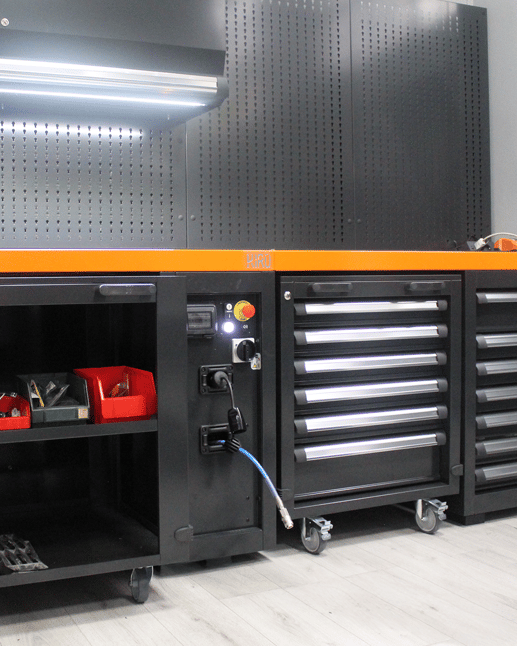 Next to the workbench, the tool trolley plays an equally important role.
Its function is not simply to store tools, but to bring them where they are needed, when they are needed. In a well-designed workstation, the trolley follows the operator without obstructing the passageway, reduces unnecessary movements, and helps keep the work surface clear.
Workbench, trolley, and utilities: what should be placed near the motorcycle lift
A truly efficient workstation does not simply place a workbench next to the lift. It studies what the operator needs while working.
The most frequently used tools must be immediately accessible. Power outlets, compressed air, hose reels, and lighting must be positioned so that they do not create obstacles. Accessories should have a precise place, preventing cables on the floor, tools left on the ground, or constant interruptions during the job.
For this reason, during the design phase, KIRO also considers the distribution of air and power as an integral part of the workstation. Energy, air, lighting, and organization are not secondary elements: they are what allow the lift and the workbench, and the technical furniture to work together as a complete system.
Workshop accessories also contribute to the quality of the layout. They complete the workstation, improve organization, and help the operator keep everything under control.
The goal is always the same: to build a workstation where everything has a precise function.
Designing an ergonomic workshop workstation
Ergonomics in the workshop is not a detail. It is a factor that affects work quality, operator safety, and productivity throughout the entire day.
An ergonomic workstation is built on the balance between lift height, workbench position, tool accessibility, lighting, pathways, and utility management. If the mechanic has to bend constantly, take unnecessary steps, or search for tools placed too far away, the quality of the work suffers. Fatigue, intervention times, and the risk of error all increase.
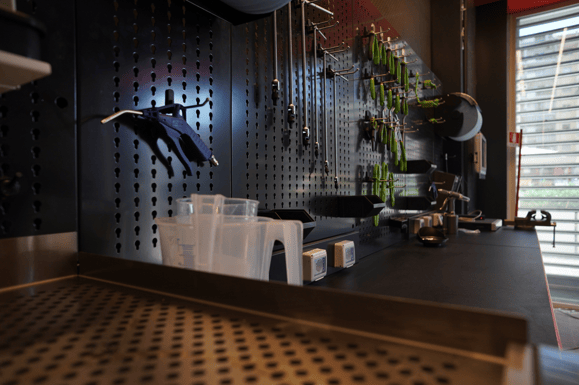 This approach reflects KIRO’s way of thinking: the workstation is not the sum of separate products, but an ecosystem designed to improve everyday work. In this kind of environment, order is no longer an obligation, but the natural result of a well-designed project.
KIRO: manufacturers and consultants for workshop setups
Choosing KIRO means relying on a partner that understands the workshop not only from a product perspective, but also from the perspective of everyday work.
Made in Italy production is a central part of this approach. It means control over materials, attention to finishes, focus on durability, and the ability to develop solutions that are consistent with the customer’s needs. But KIRO’s value does not stop at build quality.
Its real strength lies in consulting.
Every workshop has different spaces, workflows, habits, and priorities. Some need to optimize a single workstation, others want to renovate an entire technical area, expand their services, or transform the image of their environment to make it look more professional in the eyes of customers.
KIRO supports customers in choosing motorcycle lifts, arranging workbenches, and selecting tool trolleys, cabinets, equipped walls, and technical modules. The goal is not to sell separate products, but to design workshop setups capable of working as a system.
From consulting to design: why the layout comes before the purchase
Many workshops start with the wrong question: “Which product do I need?”
In reality, even before choosing a motorcycle lift, a workbench, or a tool trolley, the first question should be: “How should this workstation function?”
KIRO consulting is precisely designed to answer this questions. It does not start from the individual product, but from the working method. Only after understanding the workflow are the most suitable solutions identified: lifts, workbenches, trolleys, drawer units, equipped walls, accessories, and configurations.
This approach makes it possible to create a workshop layout that is practical, efficient, safe, and consistent with the way people actually work.
Take a look at some of our completed projects!
Cutting-edge workshop: when image reflects the working method.
An organized workshop communicates professionalism even before the work begins. When a customer enters a clean, consistent, and well-organized environment, they immediately perceives attention to detail, precision, and reliability.
This is why the concept of a cutting-edge workshop is not only about aesthetics. It is about the way the space reflects the company’s working method.
KIRO technical furniture is designed to combine strength with a professional image. Finishes, materials, modularity, and visual consistency help create an environment that is attractive to look at, but above all easy to use, maintain, and adapt over time.
In this sense, design is not just a preliminary phase. It is what allows the workshop to become a more efficient, safer, and more recognizable space.
Don’t just buy equipment, design a working method.
Integrating the motorcycle lift and technical furniture means changing perspective. It is not about simply adding a workbench, a trolley, or a lift.
It is about designing a complete workstation around the real work carried out every day in the workshop.
With KIRO, the motorcycle lift becomes the operational center of a wider system. Workbenches, tool trolley, utilities, equipped walls, and storage modules are designed together to improve safety, ergonomics, organization, and productivity.
This is what distinguishes a simple supply from a professional project.
KIRO manufactures solid, refined, and durable workshop equipment in Italy Above all, it provides a consulting-driven vision capable of transforming space into a real working tool.
Because an efficient workshop does not happen by chance.
It is designed.
FAQ
What does it mean to integrate a motorcycle lift and technical furniture?
It means designing the lift, workbench, trolleys, utilities, and movement spaces as parts of a single system. In this way, the workstation becomes more organized, safer, and more efficient.
Why is the motorcycle lift so important in a workshop?
The lift is often the center of the work process. It allows the vehicle to be positioned at the correct height, improving accessibility, operator posture, precision, and safety during the job.
Does KIRO only offer products, or does it also provide consulting?
KIRO is not just a manufacturer. It supports customers in designing their workshop by studying the layout, workflows, furniture arrangement, and integration between lifts, workbenches, and accessories.
How do you design an ergonomic workstation?
An ergonomic workstation takes into account the height of the lift, the position of the workbench, tool accessibility, lighting, utility organization, and the operator’s freedom of movement.
Why choose Made in Italy solutions for the workshop?
Made in Italy guarantees construction care, attention to materials, quality control, and greater customization possibilities. For a workshop, it means investing in equipment designed to last over time.